Ask questions about this page
Summary
For ecommerce merchants, navigating the complexities of online payments is a constant balancing act between security and user experience. In the European region and other regions with authentication mandates, this balance is heavily influenced by strict regulatory frameworks. This guide breaks down everything you need to know about 3D-Secure, from its technical foundations to strategic implementation.
Introduction to 3D Secure
What is 3D Secure
3D Secure (often abbreviated as 3DS) is an additional security layer for online card payments that verifies the cardholder’s identity during checkout. It stands for “3 Domain Server”. By requiring the customer to authenticate themselves—often via a one-time code, a biometric check, or approval within a banking app—3D Secure ensures that the person making the online purchase is the legitimate cardholder.
Why 3D Secure was introduced
The protocol was originally created by Visa and MasterCard to add a layer of security to online credit and debit card transactions. As ecommerce volumes grew, so did the threat of Card-Not-Present (CNP) fraud. 3D Secure was developed as an online security protocol to improve the safety of CNP transactions during online payments.
Key stakeholders in the 3D Secure ecosystem
The “3 Domains” in 3DS refer to the three key parties involved in the transaction:
- The Merchant/Acquirer Domain: The online shop and the bank that processes their payments.
- The Issuer Domain: The bank or financial institution that issued the customer’s credit or debit card.
- The Interoperability Domain: The infrastructure provided by the card networks (e.g., Visa, Mastercard) that facilitates communication between the merchant and the issuer.
How 3D Secure Works
Basic 3D-secure authentication flow
When customers pay online, they are temporarily redirected to their card issuer’s verification page, where extra authentication occurs. If the verification is successful, the online transaction proceeds, reducing fraud and helping protect both shoppers and merchants.
Roles of issuer, acquirer, card network, and merchant
- Merchant: Initiates the 3DS request during checkout to verify the customer.
- Acquirer: Receives the request and routes it through the payment gateway.
- Card Network: Acts as the bridge, receiving the request via its Directory Server (DS) and routing it to the correct issuer.
- Issuer: Evaluates the transaction data. It uses an Access Control Server (ACS) to either authenticate the customer silently or request further verification (a step-up challenge).
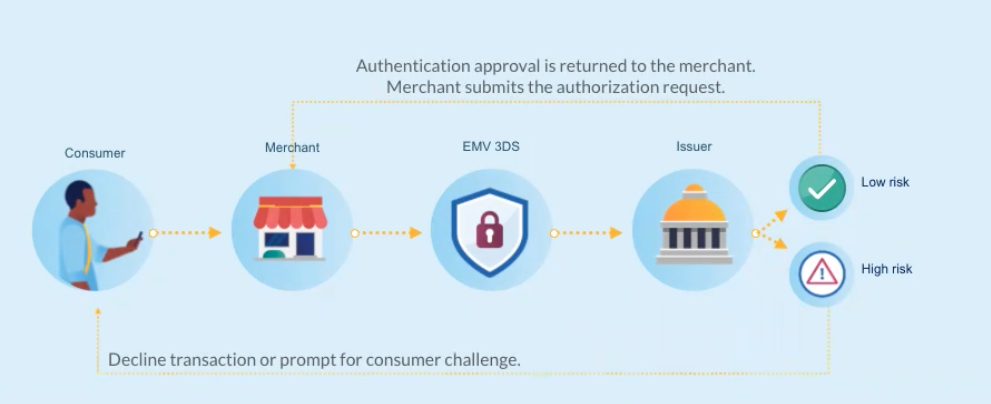
Step by step example of a 3D Secure transaction
- A customer enters their payment details at the checkout.
- The merchant’s payment gateway sends a request to the card network’s directory.
- The directory identifies the card issuer and forwards the request.
- The issuer assesses the risk. If the risk is high, a challenge (like an SMS code) is sent to the customer.
- The customer completes the challenge.
- The issuer sends an authentication success message back to the merchant, and the online transaction is authorised.

Evolution of 3D Secure
3D Secure 1.0 overview
Launched over two decades ago, 3DS 1.0 was a pioneering step in preventing fraud for online purchases, but it was built for a desktop-first world.
Static passwords and redirect pages
Initially, 3DS relied heavily on static passwords that customers had to remember. The process involved redirecting the customer away from the merchant’s site to a clunky, bank-branded page.
User experience challenges
This early version was notorious for causing friction. Customers often forgot their passwords or found the redirect pages suspicious, leading to significant spikes in cart abandonment and lost revenue for merchants.
3D Secure 2.x overview
To address the shortcomings of 1.0 and accommodate modern digital commerce, 3DS 2 was introduced. It represents a massive leap forward, prioritising data sharing and a smoother user experience.
Frictionless versus challenge flows
The most significant upgrade in 3DS 2 is the introduction of two distinct paths:
- Frictionless Flow: The issuer authenticates the cardholder in the background using rich data without disrupting the checkout.
- Challenge Flow: Triggered only when a transaction is deemed high-risk, requiring active verification (e.g., biometric scan).
Support for mobile and in app payments
Unlike its predecessor, 3DS 2 includes native SDKs (Software Development Kits) designed specifically for mobile apps. This eliminates clunky web browser redirects, allowing for seamless authentication within the merchant’s native app environment.
Improvements in user experience and conversion
By dramatically reducing the number of challenges and supporting modern authentication methods like facial recognition or fingerprint scanning, 3DS 2 improves the customer experience and helps merchants recover conversion rates previously lost to poor checkout flows.
Technical Components and Standards
Protocol and specifications
The 3DS 2 standard is maintained by EMVCo, a consortium of major card networks. These specifications ensure that regardless of the card scheme, the core communication protocol remains standardised globally.
Directory server and access control server
- Directory Server (DS): Operated by the card schemes, it validates that the card is enrolled in 3DS and routes the message to the correct issuer.
- Access Control Server (ACS): Operated by the card issuer, this server holds the authentication logic, decides whether a challenge is needed, and generates the challenge interface if necessary.
SDKs, APIs, and integration options
Merchants typically integrate 3DS 2 through their Payment Service Provider (PSP) via APIs for web checkouts, or via EMVCo-certified 3DS SDKs for native mobile applications.
Data elements used for risk based authentication
3DS 2 allows the merchant to send over 100 data points to the issuer. This includes device ID, shipping address consistency, transaction history, and browser information, which empowers the issuer to make highly accurate, instantaneous decisions.
Risk Based Authentication and Fraud Prevention
How risk scoring works in 3D Secure 2
Risk scoring relies on the wealth of data transmitted during the transaction. The issuer’s ACS evaluates this data in milliseconds, comparing it against known fraud patterns and the cardholder’s typical behaviour.
Device data, behaviour, and contextual signals
By analysing contextual signals—such as whether the customer is using a recognised device, buying from their usual location, or typing at their normal speed—issuers can confidently approve legitimate transactions without requiring a step-up challenge.
Learn more about how Signifyd helps ecommerce merchants reduce checkout friction for customers with intelligent payment optimisation.
User Experience and Design Considerations
Minimising friction during checkout
The goal of modern commerce protection is to be invisible to the good customer. Merchants should strive to qualify for the frictionless flow as often as possible by providing comprehensive transaction data to the issuer.
Designing challenge screens and flows
When a challenge is unavoidable, the design should be clean, clear, and native to the device. 3DS 2 allows for customisation, meaning the challenge window can maintain the look and feel of the merchant’s brand, preserving customer trust.
Impact on cart abandonment and conversion
Any additional step in the checkout process risks abandonment. However, by intelligently managing 3DS routing and leveraging exemptions, merchants can keep cart abandonment to an absolute minimum while remaining fully secure.
Learn more about how to reduce cart abandonment through intelligent 3D secure routing and exemptions.
Regulatory and Compliance Context
Strong Customer Authentication requirements
In the European region, the Revised Payment Services Directive (PSD2) made Strong Customer Authentication (SCA) a legal requirement. SCA dictates that electronic payments must be authenticated using at least two of three factors: Knowledge (e.g., a password), Possession (e.g., a phone), and Inherence (e.g., a fingerprint).
Learn more about strong customer authentication requirements.
Role of 3D Secure in PSD2 and other regulations
3DS 2 is the primary technological framework used by the payments industry to comply with SCA requirements. It provides the infrastructure necessary to request and process the required authentication factors.
Liability shift and chargeback implications
A major commercial benefit of implementing 3D Secure is the liability shift. When a transaction is successfully authenticated via 3DS, the liability for fraudulent chargebacks shifts from the merchant to the card issuer, protecting the merchant’s bottom line.
Integration models with payment gateways and processors
Most merchants will not build a 3DS integration from scratch. Instead, they rely on their payment gateways or specialised fraud prevention platforms to handle the complex routing and EMVCo certification requirements.
Learn more about the Payment Service Directive 2 (PSD2) and other ecommerce regulations around the world.
Choosing when to trigger 3D Secure
Not all transactions require 3D Secure. By leveraging Signifyd’s industry leading Transaction Risk Analysis and Dynamic Exemption Management engine, transactions are intelligently routed down the path of least resistance to avoid any unnecessary step ups.
Handling strong customer authentication exemptions and step up authentication
Under PSD2, certain transactions are exempt from SCA, such as low-value payments, subscriptions, or transactions deemed low-risk through Transaction Risk Analysis (TRA). Effective dynamic exemption management involves requesting these exemptions when appropriate to bypass the step-up challenge entirely.
Payment optimisation
Reduce check out friction and maximise conversions
Optimise every transaction by applying the right exemption strategy with Signifyd

Testing, certification, and monitoring
Continuous monitoring is vital. Merchants must track their authentication success rates, exemption acceptance rates, and challenge failure rates to optimise their payment routing strategies continually.
Security, Privacy, and Data Protection
Securing authentication data and channels
All data transmitted during a 3DS transaction is heavily encrypted. The EMVCo specifications mandate strict cryptographic standards to ensure that sensitive customer data cannot be intercepted during transit.
Tokenisation and storage considerations
To further protect customers, Primary Account Numbers (PANs) are often tokenised. This means the merchant stores a secure, irreversible token rather than the actual card details, minimising the impact of potential data breaches.
Privacy and customer trust
Sharing over 100 data points raises natural privacy questions. However, this data is strictly regulated under frameworks like the GDPR in Europe. It is used exclusively for the purpose of fraud prevention and authentication, which ultimately builds customer trust by protecting their finances.
Common Challenges and Best Practices
Balancing security and usability
The perpetual challenge is applying enough security to stop fraudsters without deterring legitimate customers. The best practice is a layered approach: relying on robust, AI-driven fraud management pre-authorisation, and only using 3DS as a targeted tool.
Managing cross border and multi region payments
Regulatory environments vary drastically. While the UK and EU enforce strict SCA mandates, other regions may not. Merchants must use dynamic routing to ensure they apply 3DS only where it is legally required or commercially beneficial.
Learn more about strong customer authentication exemptions
Working with multiple card schemes and versions
Different networks have different branded versions of 3DS (e.g., Visa Secure, Mastercard Identity Check). A unified payment orchestration layer or a sophisticated PSP can abstract these complexities away from the merchant.
Operational tips and optimisation strategies
- Maximise Data Payloads: Send as much contextual data as possible to issuers to encourage frictionless authentication.
- Utilise TRA Exemptions: Partner with a provider capable of performing robust Transaction Risk Analysis to claim exemptions legally.
- Monitor Analytics: Routinely check your authentication conversion rates to identify and fix bottlenecks.
Future of 3D Secure and Digital Authentication
Emerging technologies and identity solutions
The future of authentication is moving towards seamless, device-level verification. Technologies like FIDO (Fast Identity Online) and network tokens are becoming increasingly integrated with the 3DS ecosystem.
Trends in frictionless authentication
We are seeing a shift towards Delegated Authentication, where the issuer trusts the merchant (or their biometric providers like Apple Pay/Google Pay) to perform the authentication locally, entirely bypassing the need for a traditional ACS challenge.
Potential evolution beyond 3D Secure
While 3DS 2 is the current standard, the industry is already looking toward Secure Payment Confirmation (SPC) through web browsers and highly interoperable digital identity wallets, which may one day make traditional card-based authentication obsolete.
Conclusion
Summary of benefits and limitations
3D Secure is an indispensable tool in the modern payments ecosystem. It protects merchants from fraud liability and helps them comply with stringent EU regulations like PSD2. However, if poorly implemented, it can introduce friction that harms conversion rates. The key is intelligent, dynamic application rather than a blanket approach.
Key takeaways for businesses and developers
For e-commerce success, businesses must view SCA not just as a compliance hurdle, but as an opportunity to optimise the checkout experience. By leveraging rich data and strategic exemptions, you can protect your revenue from both fraudsters and false declines.
Learn more about how Signifyd can help with reducing friction and increasing conversion
More Resources