Ask questions about this page
Europe’s fashion sector has a return problem — and it is getting harder to ignore. Online return rates across the continent range from 25% to 40%, dwarfing the 8–10% seen in physical stores.
In some markets, the figures are even more alarming. Swiss fashion shoppers return 62% of their online purchases. German consumers return 44%. And in the UK, returns reached £27 billion in 2024. The economics have become unsustainable: processing a single return can cost up to 65% of the item’s original sale price in 2025, according to Loop, once you account for shipping, inspection, reconditioning, and restocking. For high-volume online retailers, that math compounds quickly.
From cost problem to abuse problem
What makes the European returns landscape particularly complex, is not just the volume, it is the behaviour driving it. Research shows that 69% of shoppers admit to wardrobing in 2024: purchasing items with the deliberate intention to wear and return them. Bracketing, buying multiple sizes or colourways with the intention of keeping just one, is now routine. With 51% of Gen Z and Millennial shoppers engaging in the practice regularly. Nearly 62% of consumers admit to at least one form of costly or abusive return behaviour. And 45% say it is acceptable to “bend the rules” on returns, a figure that climbs to 66% among Gen Z.
The consequences are significant. Wardrobing alone costs UK retailers an estimated £1.5 billion annually. Fraud more broadly cost UK retail £11 billion in 2023. These are not rounding errors — they are existential pressures on already margin-thin businesses.
The policy response: necessary but insufficient
The industry has not stood still. A wave of European fashion retailers have moved to tighten or monetise their returns policies. ASOS introduced tiered return fees based on individual return behaviour, charging customers who consistently return 70–80% or more of their orders £3.95 per return, while retaining free returns for lower-rate customers. H&M raised its UK return fee to £2.95. Zalando has reduced its returns window in certain markets from 100 days to 30 days.
These are meaningful shifts. But as Xavier Sheikrojan, Director of Risk Intelligence EMEA at Signifyd, argues in a piece for the Merchant Risk Council, they remain reactive: “Transparency and fees are useful signals but they are also reactive tools, responding to damage that has already been done.”
The ASOS model is instructive precisely because it attempts something more nuanced than a blanket charge. By making individual return rates visible to customers and tying consequences to their own patterns, it introduces a form of behavioural accountability. That is progress. But it is still operating after the fact.
The variance problem that policy cannot solve
Sheikrojan’s central argument resonates across the European fashion market: the returns problem is not one of volume alone, it is one of variance. A customer who orders multiple sizes and keeps the majority is fundamentally different from one who repeatedly orders with no intention to keep. Yet most policy frameworks treat them identically, and that failure is costly.
Blanket return fees risk penalising the loyal, genuine customer who bought the wrong size alongside the serial abuser gaming the system. In a competitive landscape where lifetime value is everything, that is a dangerous trade-off. What is needed is not better policy, but better intelligence — systems that can distinguish between these customer types at the moment a return is initiated, not weeks later.
The intelligence layer
The data required to make these distinctions already exists. Order cadence, return history, item condition, customer lifetime value, cross-channel behaviour: these signals are already being tracked. What most retailers lack, as Sheikrojan identifies, is the infrastructure to act on them dynamically.
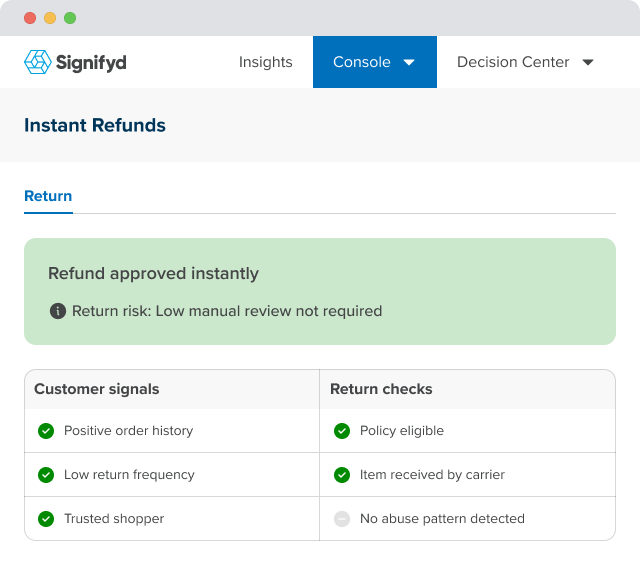
Drawing on a network spanning thousands of merchants and hundreds of millions of consumer interactions, like Signifyd, it surfaces behavioural signals that no single retailer could generate alone, enabling order-level decisions rather than policy-level rules. A high-value, low-risk customer initiates a return and receives an immediate refund. A customer exhibiting serial abuse patterns encounters a different journey: additional verification, a delayed refund, or a “keep it” resolution where the unit economics make more sense than processing the item back. The policy has not changed. The application of it has.
A reputational dimension, too
European retailers also face a sustainability reckoning they cannot afford to sidestep. Returns generate an estimated five billion pounds of waste globally each year and contribute 15 million metric tonnes of CO₂ to the atmosphere. With EU textile legislation gaining momentum and consumer awareness of overconsumption growing, the environmental cost of unchecked returns is becoming a brand and compliance issue, not just an operational one.
Blanket fees, while financially logical, can read as punitive to consumers who feel they are being penalised for legitimate behaviour. A behaviour-led model — one that distinguishes between the genuine customer and the serial abuser — offers a more defensible and commercially sustainable path forward.
The divide is widening
The retailers moving earliest on intelligent, contextual returns management are not just reducing fraud and abuse. They are protecting the experience for their best customers, compressing return cycles, and retaining revenue through smarter resolution decisions. Those still relying on static rules are falling behind.
The question for European fashion retail is not whether to charge for returns. It is who, when, and why — and whether their systems can answer that question in real time.
Fees may be shaping the headlines. Intelligence will shape the outcome.
To read more visit: “The Returns Reckoning: Why Intelligence, Not Fees, Will Define Retail’s Next Move” by Xavier Sheikrojan, Director Risk Intelligence, EMEA, Signifyd.
RETURN ABUSE PREVENTION
From return abuse to protected margins
Discover how Signifyd helps merchants protect revenues, while reducing friction for trusted customers
Explore More